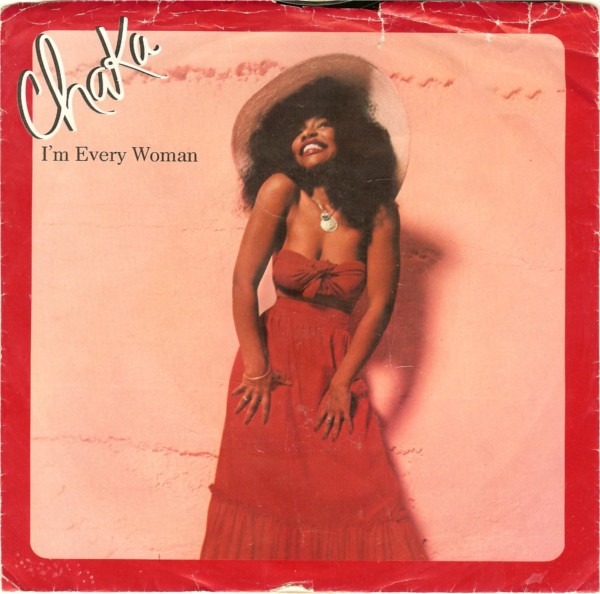
“I’m Every Woman”! Am I really? Are YOU?
Never Date an Artist because they’ll make you question and revisit your principles by listening to a simple song. But there’s nothing simple about “I’m Every Woman” by Chaka Khan: a women’s anthem or an ode to the feminine role?
Artist – CHAKA KHAN
Song – “I’m Every Woman”
Album – Chaka (1978)
I’m about to do something sacrilegious to most music fans: to desecrate one of the most famous hits ever to stand the test of time, sung by one of the most powerful voices to grace the Funk, Contemporary R&B, and Soul styles. The song is Chaka Khan’s “I’m Every Woman”. Happy International Women’s Day!
Since yesterday, I’ve struggled to find a song that expresses my feelings and thoughts about International Women’s Day! At a time when “Feminism” is once again the F-word (it has probably always been throughout the ages – who am I kidding?), celebrating this day starts to have a transgressive undertone. Or is it just me?
Be it as it may, I’m celebrating it as it should be. And if you’re ready to spew out unreasonable remarks such as “What about an International Men’s Day?”, please do not remain in this space because I’m not in the mood. (You’re welcome to stay if you want; it pains me to be rude! But I hope you got the message!)
International Women’s Day, the soundtrack: a challenging selection
So, which song best describes the challenges, struggles, unique moments of happiness, and trials and tribulations that women go through? There is no single one, but several songs spread through different decades. To simplify the process, I first considered the artists, female artists, and then the possible hits, anthems, or song titles best suited for this day’s celebration and my emotional state. Isn’t it so stereotypically womanly of me? And I couldn’t care less!
My first instinct was Nina Simone. I thought about “Feeling Good” and even “Four Women”. But I’m not in the right state of mind to talk about Aunt Sarah’s pain, Safronia’s raw feelings about her heritage, Sweet Thing’s objectification, and Peaches’ socially assumed bitterness. I wouldn’t be doing them justice, and that would be unfortunate. Queen Latifah’s U.N.I.T.Y. was the runner-up and even took first place briefly, but then I opted for another classic: Chaka Khan’s “I’m Every Woman”.
“I’m Every Woman” – a solo debut
“I’m Every Woman” (1978) launched Chaka Khan on a glittering solo career while still fronting Rufus as the band’s lead singer (her official departure only happened a few years later, in 1983). Her majestic vocals just needed a solo project to elevate the singer to the higher echelons of music. Thus, she took the opportunity to unleash her mighty vocals on various hits, such as Prince’s “I Feel For You” (1984) and, of course, “I’m Every Woman”. The list of hits under her belt is not long, but everlasting.
Funnily enough, the first time I listened to “I’m Every Woman”, it was not in Chaka’s robust voice but Whitney Houston’s. As far as I knew, it belonged to The Bodyguard‘s (1992) soundtrack, and Whitney was merry and pregnant in the music video. Later, I learned that one of the cameos, Chaka Khan herself, was the lady who had taken the song to the top of the charts first: it was number one on the US Billboard Hot Soul chart and number 11 in the UK singles chart.
For a while, I preferred Whitney’s version: not only was I mesmerised by her and her vocal talent, but I also loved the surprising dance rhythm that the melodic intro didn’t immediately give away. However, I was blissfully unaware of one of the central parts of the song: the lyrics. I had no idea what “I’m Every Woman” was about; I was just interested in mimicking the video’s choreography. And I reckon I can still do it, provided I sleep on a firm mattress the day before and have an efficient pillow that supports my neck. That and warm socks are little luxuries to my sweet millennial heart. But I digress…
The ‘surprising’ lyrics
Today, I finally took a good look at the lyrics and read them from top to bottom. So… Am I every woman? I didn’t relate. My first impression is that it sounds like a song about a woman who proudly announces her high qualifications for catering to her man: Anything you want done, baby/ I’ll do it naturally. There’s more:
I can cast a spell
With secrets you can’t tell
Mix a special brew
Put fire inside of you
But anytime you feel
Danger or fear
Instantly, I will appear, ’cause
‘Cause I’m every woman, it’s all in me. What is this?
Ok, it might be relevant to mention “I’m Every Woman” was written by the famous husband-and-wife duo Nickolas Ashford and Valerie Simpson, also responsible for famous Motown hits such as “Ain’t Nothing Like the Real Thing”, “Ain’t No Mountain High Enough”, and ‘Ain’t No Such Thing as “I’m Every Woman!” (Oops, wrong title). Clearly, the issue is not with the credentials. It caught my attention, though, Valerie’s admission that her husband wrote most of the lyrics for their tracks, and “I’m Every Woman” was no exception. Was Nickolas trying to pass a clear message to Valerie? Was he manifesting? If that’s the case, there’s no subtlety there.
That undeniable feeling of discomfort
Be it as it may, I know I’m not the only one feeling discomfort with “I’m Every Woman”: Chaka Khan herself admitted on Jennifer Hudson’s show in 2022 that it took her a long time to feel comfortable singing the song because she was taking the words literally, which we’re not supposed to do. “I was reading it from an insecure place”, the singer said. “The song is talking about it in a plural, collective way; we are all every woman, and it’s all in us”. I grasp the meaning of Ms Khan’s words, but I still relate to her first reaction: discomfort.
Have you seen JHud’s face? She doesn’t seem comfortable either!
Considering that “I’m Every Woman” was released in 1978 and this interview is from 2022, I definitely need more time to feel at ease (if ever) with the lyrics, and yes, I’m taking the words literally. Either in the singular or plural form, I cannot shake off the uneasiness with the image of a super, prescient woman who uses all her talent to perceive and satisfy her partner’s needs.
I can sense your needs
Like rain onto the seeds
It sounds almost magical what this woman, excuse me, ‘every woman’, can do. In times of yore, we would be burned at the stake with a witchcraft accusation tarnishing our good name and bodies for the rest of eternity. Today, songs like “I’m Every Woman” advocate being a witch, or at least an effective medium in the name of love… or servitude. Too far? Again, is it just me?
“I’m every woman” and “I’ll do it naturally”
I’m every woman, it’s all in me
Anything you want done, baby
I’ll do it naturally
I’ve always been baffled by the roles that have been prescribed to us as “natural” or designed for our nature. Who decided that? From the moment I realised those roles existed, I got the impression a memo didn’t reach its destination. Who consented to the “woman role” for me? Because I was surely not present at the meeting. Probably not even Eve! Was it the snake who came up with this master plan, then? I may not like it, but I must confess it’s ingenious: so masterfully designed that it has shaped our understanding of gender normativity throughout the centuries (at least, on this side of the globe). But isn’t all of this just a construction: all those rules, prescriptions, and norms?
I’m not opposed to women being perceived as special beings. I love the idea of women’s intuition, for example. But “I’m Every Woman” goes beyond that: it’s the confessions of a seer. If I had that kind of power, I wouldn’t be advertising it to the world! Nobody would know… But there would be signs! (Cue self-satisfied smirk).
Should I be concerned that I’m not nurturing my intuition enough to the point of witchcraft or… divinity? The woman as a goddess: it has a nice ring to it! I’ve always been drawn to the concept of the Divine Feminine, now that I think about it. But I’ve never correlated women’s proclaimed superpowers with divination, omnipresence, and incantations. Wait… Actually, I have. I’ve just been wary of using them at the service of a man. With great power comes great responsibility, and I do not wish to hurt anybody. However, in “I’m Every Woman”, the word man does not show up once. Thus, I might be jumping to conclusions, but that only shows how closely aligned I am with the stereotype.
Never Date an Artist because…
Well, there comes that part where I stress Never Date an Artist because they will make you question and revisit your principles by listening to a simple song. It shouldn’t be that simple! But now the question: who practised witchcraft first: the man who wrote the lyrics (Nickolas Ashford), or the female artist who sang them (Chaka Khan)? Based on history and folklore, the latter, because she can ‘naturally’ cast a spell/ With secrets you can’t tell/ Mix a special brew/ Put fire inside of you, and instantly appear. Why? Because she’s every woman!
In reality, more important than being treated as a deity is to be treated as a human being. And that’s what I assume every woman aspires to all over the world.
Happy International Women’s Day!
So, do you think “I’m Every Woman” was meant to be taken as irony, or does it make perfect sense in your life? Did you find my words too harsh? Then let me know about it in the comments below. And if you’d like to feel inspired by the talent of other great female artists, then click here to see what Never Date an Artist has to offer.
Carla Vicente

Music and sun lover. I live for good weather, food, beauty, inspiration, and deciphering the complexity of human relations. Unharnessed creativity is a blessing, and I'm deeply grateful for mine. My world is made of innumerable words in different languages, with multiple figures of speech. Subtlety is an art form. Directness... a work in progress. Silence: the space where loud and creative thoughts gain shape and prosper.
I sang along to this song in International Women’s Day in my city. I actually come from a non-English speaking country, and I just paid attention to the chorus—“I’m every woman, it’s all in me.”—which felt empowering.
Two days later I look up the lyrics, and it made me sick. The speaker in the lyrics is obviously addressing a man. The lyrics feel uncomfortably sexual. I feel your discomfort, and I too sense the discomfort in Chaka Khan. She made it a powerful song, but the intention of the lyrics was clearly not to empower women.
Thank you for this!
Hi G Kim! Thank you for reading the article and for your comment. I also felt empowered for years, until I looked at the lyrics. But to be fair, Chaka Khan’s powerful voice wouldn’t let me suspect otherwise. Today, I still enjoy the song, but with my ‘ears’ open. NDAA